Want to try our resources? Sign up for our 14-Day Free Trial

Should fireworks be quieter?

9th - 13th November 2026

Back to results

60005

Total votes

13061

5-11 votes

46944

11-16+ votes

For many, fireworks are a key part of the soundtrack to this time of year. Both Bonfire Night and Diwali help to mark the transition from Autumn to Winter, with loud and colourful bangs lighting up our towns and cities. But for pets, wildlife and those sensitive to noise, it can be a time of fear and anxiety. Fireworks on sale to the general public currently have a sound limit of 120dB. Earlier this year, the government held a 12-week consultation on changes to firework rules, notably including proposals to reduce this limit to anywhere from 110dB to 90dB (about the volume of a lawnmower). Though no decision has been announced thus far, would young people welcome this change?

60,005 voted on this topic, with many more participating in classroom discussions.

Primary, Secondary and 16+ & College voters debated, "Should fireworks be quieter?"
child

Age 5-11 voter

The noise is part of the experience of Bonfire night. I wouldn't want that to disappear, although I understand why many people would want them to be a little bit quieter.

teen

Age 11-16 voter

Fireworks whilst visually impressive, terrify many domestic pets and local wildlife, causing unnecessary panic and distress.

student

Age 11-16 voter

No, it is meant to be loud, people go far and to bigger displays for the noise. It would ruin the experience for people who like fireworks.
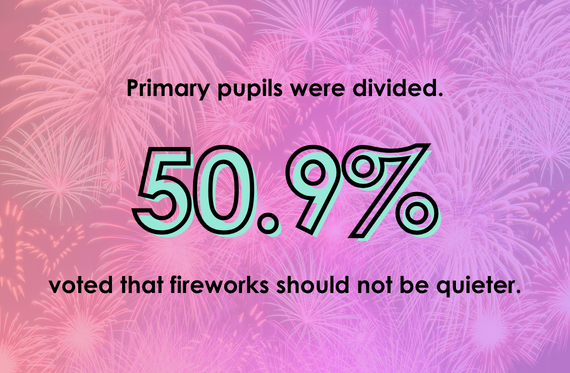
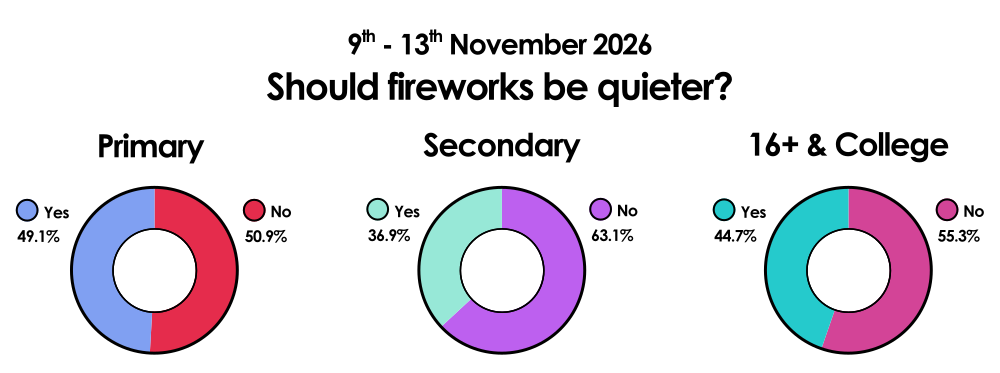
Primary pupils were divided. 50.9% voted that fireworks should not be quieter.

  • 'No' voters thought that noise was a key part of the fireworks experience. They wanted them to be loud and some wanted them louder than they already were.
  • For some, fireworks were important for specific holidays and helped to spread the celebration.
  • Most 'Yes' arguments focused on the negative effects to humans and animals. Voters emphasised how distressing fireworks can be to pets and wildlife.
  • Many argued that fireworks disturb people who are trying to sleep.
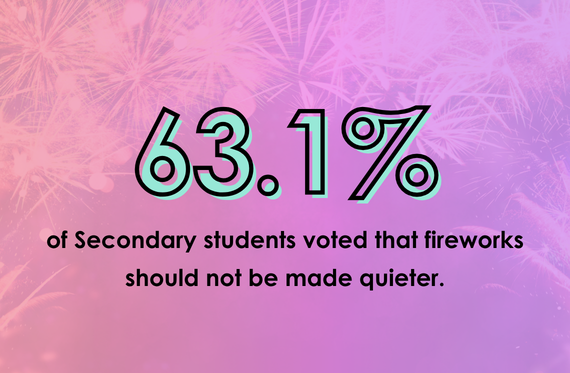
63.1% of Secondary students voted that fireworks should not be made quieter.

  • Secondary 'No' voters agreed that the noise was a key part of the fireworks celebration and that quieter bangs would ruin celebrations.
  • Many made a distinction between public firework displays and home use, wanting a limit to the latter but organised displays to be free of any sound limit.
  • Several voters complained about people using fireworks late at night or weeks after a particular holiday had passed. Though they did not have an issue with the noise in general, these voters wanted stricter controls around the times fireworks could be used.
  • 'Yes' voters focused on the negative effect fireworks can have on animals.
  • Others argued that quieter fireworks were better for neurodivergent people and those with sensory needs.
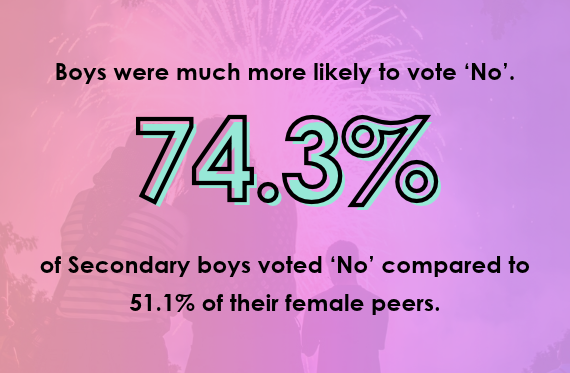
Boys were much more likely to vote 'No', 74.3% of Secondary boys voted 'No' compared to 51.1% of their female peers.

  • At every age, boys were more likely to vote 'No' than girls.
  • The difference was most substantial amongst Secondary voters.
  • Younger voters were generally more in favour of quieter fireworks than their older peers. 57.5% of Year 1 students wanted quieter fireworks compared to just 34.0% of Year 10s.
results