


Smart glasses have been around in one form or another for years, but they're starting to feel a lot less like a novelty. Cameras, microphones and AI can now sit inside frames that look increasingly like an ordinary pair of glasses, giving wearers information about what's around them, translating languages and taking photos or videos without reaching for a phone.
For schools, that creates an interesting problem. There are some genuinely useful possibilities here, particularly around accessibility, but also some fairly obvious questions about privacy and consent. If it's no longer obvious when somebody is using a camera, what does that mean for the people around them?
And, perhaps more importantly, what will young people make of it all?
- What are smart glasses?
- The privacy question is hard to ignore
- But there's another side to the story
- What could smart glasses mean for schools?
- So, would young people actually wear them?
- Why is this a useful conversation for PSHE and RSHE?
- Keeping the conversation current
What are smart glasses?
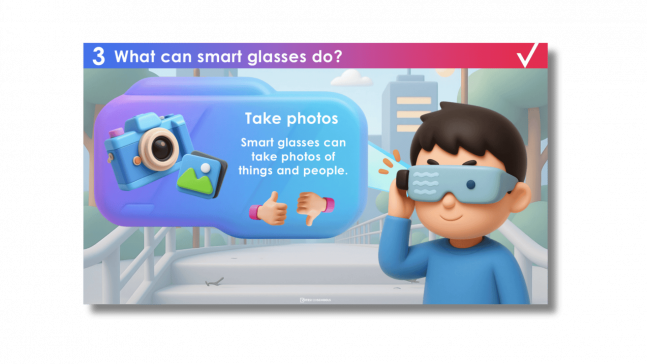
Smart glasses are wearable devices that combine eyewear with digital technology. What they can do depends on the model, but features can include cameras, microphones, speakers, navigation and AI tools that respond to what the wearer can see or hear.
Some of the appeal is easy to understand. Rather than stopping to look something up on your phone, information can be available while you're looking at the thing itself. Directions could appear or be spoken as you walk, languages can be translated and a photo can be taken without getting another device out.
There are accessibility possibilities too. In our recent VoteTopic, pupils considered how smart glasses could describe someone's surroundings in detail to support a person who is partially sighted.
So far, pretty useful. But the same thing that makes smart glasses convenient also makes them complicated: much of what they're doing can happen without everyone else necessarily knowing.
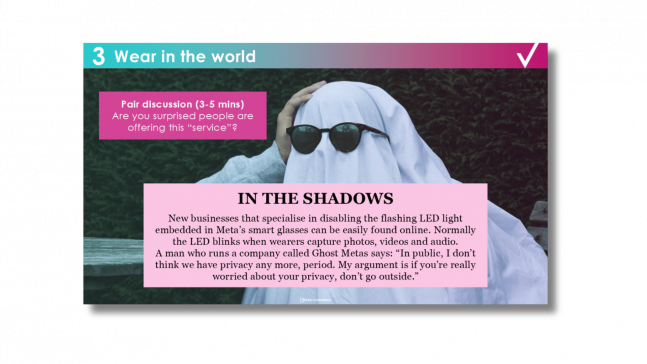
The privacy question is hard to ignore
Most of us recognise the little social cues that tell us someone is taking a photo. A phone comes out, a camera gets pointed in our direction and, ideally, somebody asks first.
Smart glasses can make those cues much less obvious.
That raises questions about privacy and consent, particularly for young people who are already growing up in a world where taking, sharing and appearing in images is completely normal. Knowing that somebody could be recording is one thing. Knowing whether they actually are is another.
It's an issue that works at different levels depending on a pupil's age. Our 5–7 VoteTopic kept things straightforward, asking children to think about what happens when someone takes a photo without asking, when somebody doesn't want to be included in a picture, or when a person carries on after being asked to stop.
With older pupils, the questions become less straightforward. Is it reasonable to wear smart glasses everywhere? Should certain spaces have different rules? And when technology changes faster than our social expectations, who gets to decide what's acceptable?
But there's another side to the story
It would be easy for the conversation around smart glasses to become entirely about surveillance, and that misses some of the reasons people are interested in them.
Accessibility is an important one. Technology that can describe surroundings could make everyday experiences easier for some blind and partially sighted people. Real-time translation could change how people communicate and travel, while hands-free access to information could have interesting applications for learning.
There's even an argument that smart glasses could mean less time staring at our phones. If you can get directions, take a photograph or find information without reaching for a screen, perhaps technology becomes less intrusive rather than more.
Or perhaps we're just moving the screen closer.
That's what makes the subject worth discussing with young people. The benefits and drawbacks aren't particularly neat, and something can be useful while still creating problems we need to think about.
What could smart glasses mean for schools?
It's probably too early to know exactly how significant smart glasses will become in schools, but many of the questions they raise are already familiar.
Schools have spent years working through the realities of smartphones: when they can be used, where they belong, what happens when somebody records another pupil, and how young people should behave when the boundary between online and offline life gets blurry. Smart glasses don't make those questions disappear. If anything, they make some of them harder to spot.
That doesn't mean schools need to start writing a smart-glasses policy tomorrow. It does mean conversations about digital literacy, privacy, consent and responsible technology use need to keep pace with the devices young people encounter.
And there's something useful in discussing the technology before it becomes completely ordinary. Pupils can question what they're comfortable with while the rules and expectations around it are still being worked out, rather than only thinking about those questions once habits have already formed.
So, would young people actually wear them?
That's what we wanted to know.
Our recent VoteTopic asked pupils aged 11+ “Would you wear smart glasses?”, while younger pupils considered “Should people wear smart glasses?”.
Rather than treating it as a straightforward technology question, pupils considered what smart glasses might mean in real situations: travelling somewhere unfamiliar, supporting somebody with sight loss, taking and sharing photographs, being connected throughout the day, or simply being around somebody wearing a camera.
Older pupils also considered where smart glasses should and shouldn't be allowed, including restrictions in courts and wider questions about filming people in public.
The interesting bit isn't whether smart glasses get a Yes or a No. It's the thinking that has to happen before pupils can decide.
Why is this a useful conversation for PSHE and RSHE?
Smart glasses are new technology, but the skills pupils need to think about them aren't particularly new.
There's online safety and digital literacy: understanding how technology works, questioning what it can do and thinking about its consequences. There's privacy, consent and boundaries: recognising that being able to capture something doesn't automatically mean you should.
There's critical thinking too. Young people are surrounded by messages telling them which new products will make life easier, better or more exciting. Being able to enjoy technology while still questioning what it asks of us is a useful skill to have.
For older pupils, there are wider Citizenship questions as well. Where should responsibility sit when technology creates a new problem? With the person wearing it? The company making it? The school? Or the law?
These are exactly the kinds of questions that don't necessarily come with a tidy answer, but do give pupils plenty worth talking about.
Keeping the conversation current
Technology isn't going to wait for the next update to a scheme of work. New devices, platforms and online trends will keep appearing, and young people will usually encounter them long before adults have decided exactly what to make of them.
That's why VotesforSchools creates new VoteTopics every week, giving pupils the chance to explore real-life issues while they're actually happening, hear different perspectives and decide where they stand.
Smart glasses might be the conversation this week. Next week, it'll be something else.
Want to explore the kinds of conversations pupils could be having in your school? Try a free VotesforSchools lesson or start your free 14-day trial.
Can't see the form? Click here to start your trial!
Can't see the form above? Click here to start your trial!