


This week at VotesforSchools, we’ve teamed up with the Children’s Commissioner for England as part of The Big Future to ask pupils a pretty big question: ‘Do you feel hopeful about your future?’
It got me thinking about what hope for the future actually looks like when you’re young, what shapes it as you grow up and, inevitably, what I thought my own future was going to look like. As it happens, Year 6 me left me some evidence.
Are you hopeful about your future?
I recently found a gorgeous memory in some boxes at my parents’ house, amongst old photographs featuring toothless smiles and questionable glasses: a piece of writing from Year 6 about what I thought my future would look like.
‘I am hoping to go to [school name] high school. I would like to do literacy and journalism in university. I would love to be a qualified author or illustrator. My ambitions are to have a family and live in the countryside. When I am 18 or 19 I would like to come back to this school and find out what has changed and how it has changed and meet up with all my school mates.’
Want to know the spoilers? I studied Philosophy, became a qualified teacher, and now work in marketing in education. I’m still working on the family, I’m a city girl through and through, and I did make it back to my primary school when I was 14, feeling like I was SO old.
What surprised me, though, was the illustrator bit. I’d completely forgotten there was ever a point when I thought that was something I could do.
In Year 4, I was given pupil of the week for ‘the best pencil sketch I’ve ever seen from a pupil of mine’. By Year 7, I had a grumpy art teacher who once gave us a 30-minute lecture about putting our erasers in the washing machine, and a C- with ‘Could do better’ underneath my poorly shaded apple.
Obviously, one badly shaded apple didn’t decide my future. But somewhere along the way, I’d stopped thinking of myself as someone who could draw. And it made me wonder what shapes the things young people believe are possible for their future.
What shapes how young people feel about their future?
We start talking to children about their future pretty early. What do you want to be when you grow up? is usually harmless enough, especially when the answer changes from astronaut to vet to YouTuber in the space of a week. My niece, on the other hand, is firmly set on scientist (she’s 4). My sister-in-law asks her every year and keeps a record, which I really want to see in 20 years’ time.
As children get older, those conversations naturally change. Subject choices, exams, college, university, apprenticeships and jobs start to appear, along with questions about money, relationships, where they might live and what they actually want from life. And then there’s the world those plans are supposed to happen in.
Young people are growing up thinking about artificial intelligence (AI), climate change, crime and conflict alongside all the personal stuff. They’re taking in messages about their futures from the news, social media, friends, family, school and their own experiences. Some of those things might make the future feel exciting, while others might make it feel uncertain.
Which is why ‘What do you want to do in the future?’ is quite a different question from ‘How do you feel about your future?’
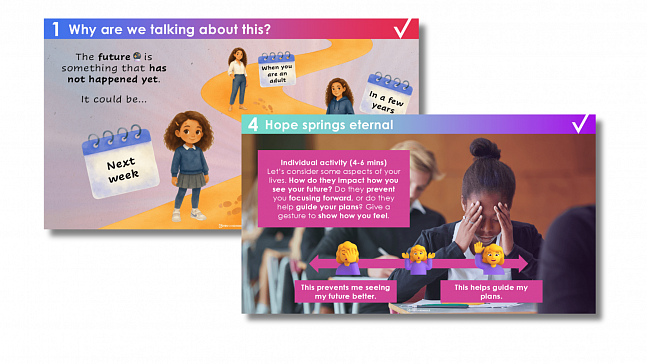
Are young people hopeful about their future?
That’s what this week’s VoteTopic gives pupils the chance to explore. Created in collaboration with the Children’s Commissioner for England as part of The Big Future, ‘Do you feel hopeful about your future?’ gives pupils from age 5 upwards space to think about what they’re looking forward to, as well as what might make the future feel less certain.
For younger pupils, that means imagining what their lives could look like and thinking about some of the things that might affect them along the way. Older pupils explore a wider mix of personal and global concerns, from exams, jobs and money to health, housing and the influence of news and social media.
But this isn’t about telling young people they should feel hopeful. Feeling uncertain about the future is allowed too. Instead, pupils have the chance to think about what makes them feel hopeful, what might be worrying them and, importantly, what they think could make their future better.
They then cast their vote and share their ideas. Their views will be shared with the Children’s Commissioner for England and other Impact Partners, while pupils are also encouraged to take part in The Big Future survey.
Talking about the future in school
Maybe the point isn’t that we need to make young people feel hopeful about their futures. There are things they’ll feel uncertain about, and rightly so, as well as things they’re excited about that adults might never have considered. Perhaps what matters is giving them the chance to tell us.
School is one of the places where young people can have those conversations. Not just about what job they want one day, but what they actually picture when they think about their future, what they’re looking forward to, what worries them and what they think could make things better.
And perhaps that’s why finding my Year 6 writing felt so lovely. I got to see, years later, what younger me thought was possible before life, growing up and a few poorly shaded apples got in the way.
I didn’t become an illustrator or move to the countryside, and there’s still time for some of Year 6 me’s plans yet. But I do still write.
So she wasn’t completely wrong.
Rachael is part of the marketing team at VotesforSchools. Before joining the team, she taught in Italy for five years. She has a degree in Philosophy and a qualification in children’s counselling, and is passionate about giving young people opportunities to form and share their own thoughts and ideas.