


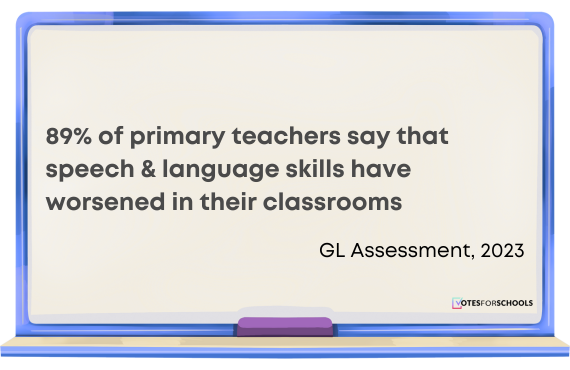
If you’ve found yourself in a classroom lately thinking, “Why aren’t they talking?”, you’re not alone. The decline in children’s speech and language skills since 2020 is widely acknowledged, with 89% of primary teachers in one survey saying these skills have worsened in their classrooms. This isn’t just a problem for the English lead to solve; it’s a challenge for every subject, every teacher, and every pupil.
This blog is your go-to guide on why oracy matters, how it affects learning across the board, and how VotesforSchools helps schools make talk a tool for progress.
What is oracy, and why is it more than “just talking”?
Oracy isn’t a new fad. The term was coined by academic Andrew Wilkinson in the 1960s to give speaking and listening the same weight as reading and writing. More recently, the Oracy Education Commission (2024) defined it as:
"Articulating ideas, developing understanding and engaging with others through speaking, listening and communication."
Crucially, this definition acknowledges that communication doesn’t always happen through spoken language. Sign language and augmentative communication devices are also part of the oracy conversation, making it more inclusive and relevant to all learners.
So, what are oracy skills? According to Voice 21 and Oracy Cambridge, they fall into four strands:
-
Physical: tone, pitch, volume, gestures
-
Linguistic: vocabulary, grammar, rhetorical techniques
-
Cognitive: structure, reasoning, building on others’ ideas
-
Social and Emotional: confidence, active listening, group interaction
Far from being vague or fluffy, oracy is a concrete, teachable set of skills that underpin not just learning, but confidence, empathy, and resilience too.
If you're looking for information about oracy in the National Curriculum, and what Ofsted are looking for with oracy, you can find all of the answers at our Oracy & The National Curriculum Blog.
Why is oracy in crisis?
It’s not surprising that the last few years have hit children’s communication skills hard. Lockdowns, isolation, and screen time all contributed to a slowdown in speech development, especially for younger pupils.

GL Assessment’s Lost for Words report (2023) found that up to 40% of children in some classrooms are struggling to meet age-related expectations in speaking and listening. Many present with issues in sentence structure, tense usage, and even basic sound development.
But the impact goes far beyond grammar.
When children can’t express themselves clearly, it affects:
-
Their ability to access the curriculum (especially in subjects where verbal reasoning is key)
-
Their behaviour (frustration often manifests as disruption)
-
Their mental health (being unable to participate leads to lower self-esteem and increased anxiety)
-
Their future prospects (employers rank communication in the top skills they’re looking for)
And yet, while we have assessments galore for reading and writing, oracy is often left to chance.
Why it matters now more than ever
Oracy isn’t just an education issue; it’s a social justice one.
Research shows that children from disadvantaged backgrounds are less likely to have exposure to the rich, sustained conversations that build language (Law et al, 2017). Without targeted support, these gaps only widen over time. The Education Endowment Foundation (EEF) highlights oral language interventions as one of the most effective ways to raise attainment, especially for younger learners.
"Oral language approaches have a high impact on pupil outcomes of +6 months." – EEF Teaching Toolkit (2021)
Inclusion also plays a big part. A broad and inclusive oracy definition ensures that multilingual learners, neurodivergent pupils, and those using alternative communication are not left behind. Instead, they are supported to develop their own voice in ways that suit them.
How VotesforSchools embeds oracy across the curriculum
At VotesforSchools, we don’t bolt oracy onto lessons as a bonus extra. It’s built into the DNA of every VoteTopic.
Here’s how:

-
Weekly, structured discussion
-
Every lesson revolves around a current, relevant question (e.g. "Should we be worried about AI?") that encourages pupils to express opinions, back up ideas, and explore counterpoints.
-
-
Explicit teaching of talk routines
-
Our lessons and assemblies are structured around talk: each resource includes a variety of activities that ignite conversation and guide pupils into learning oracy skills without even realising it.
-
-
Cross-curricular opportunities
-
Our VoteTopics span nine themes from science to social justice, helping pupils practise different types of talk (explaining, reasoning, debating) in different contexts. Not only does this help pupils become informed about a range of topics, it also means that the lessons are sure to pique the attention of every single member of your classroom.
-
-
Scaffolded participation
-
We provide multiple entry points into discussion for all learners, including EAL pupils, those with SEND, and quieter children. Our resources are all easily editable for different needs, and are a HIT in many SEND schools.
-
-
Feedback and reflection
-
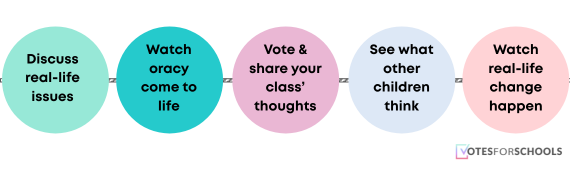
At the end of each lessons your pupils will have formed a Yes or No answer to the weekly question. As their teacher, you will collect these votes and enter them into your VotesforSchools profile, where you and your class can see how the rest of the school and country are voting. Then, in the next lesson, you'll see what both pupils and professionals across the country have to say about their vote.
-
What can schools do now?
Here are four low-lift, high-impact ways to champion oracy:
1. Treat oracy like a skill, not a personality trait
Every child can be taught to express themselves clearly. Use sentence stems, model talk, and praise listening as well as speaking.
2. Build routines around talk
Turn-pair-share, trio discussions, and think-alouds should be as routine as spelling tests.
3. Create inclusive talk environments
Not everyone wants to speak up in a whole class. Use small group discussion, visual prompts, and non-verbal ways of contributing (e.g. emojis, voting tools).
4. Use VotesforSchools to embed oracy weekly
Our resources make it easy to bring structured, inclusive talk into your curriculum – and show impact with every vote cast. They don't just 'tick' the oracy box, but make it an integral part of your school ethos.
Want to trial VotesforSchools?
When oracy is overlooked, the quiet children stay quiet. But when it’s embedded into school life, those same children learn how to form opinions, express themselves, and challenge ideas with confidence. They become not just better learners, but better citizens.
Oracy deserves more than lip service. It deserves planning, modelling, scaffolding, and celebrating.
And with VotesforSchools, it can happen every single week. You can trial our lessons for free with our 2-week trial. No card details, no sneaky payments. Just oracy resources at your fingertips.
Useful Links & Research
-
GL Assessment, Lost for Words (2023): https://www.gl-assessment.co.uk/news-hub/press-releases/89-of-teachers-say-speech-and-language-skills-have-worsened/
-
Oracy Education Commission, We need to talk (2024)
-
Voice 21 Oracy Framework: https://voice21.org/oracy-framework/
-
Education Endowment Foundation (EEF), Oral Language Interventions: https://educationendowmentfoundation.org.uk/education-evidence/teaching-learning-toolkit/oral-language-interventions
-
Law et al. (2017), Talk of the Town: Speech, Language and Communication in Disadvantaged Areas: https://www.bettercommunication.org.uk/