Want to try our resources? Sign up for our 14-Day Free Trial

Can young people lead the way to reduce knife crime?

15th - 22nd May 2026

Back to results

45645

Total votes

10407

5-11 votes

35238

11-16+ votes

Knife Crime Awareness week, running from 18th-24th May, aimed to shine a light on the important work being done to reduce knife crime in Britain and to start conversations about what else can be done to halt this devastating issue. April saw the launch of the Government’s “Protecting Lives, Building Hope” plan, which aims to halve knife crime in the UK by 2036. Based around four pillars of Support, Stop, Police, and End, the plan seeks to tackle the root causes of the issue, as well as improving the response of the criminal justice system. As the demographic most likely to be directly affected by knife crime, we wanted to know how young people viewed themselves and the role they could play when it comes to stemming the tide of knife violence on our streets.

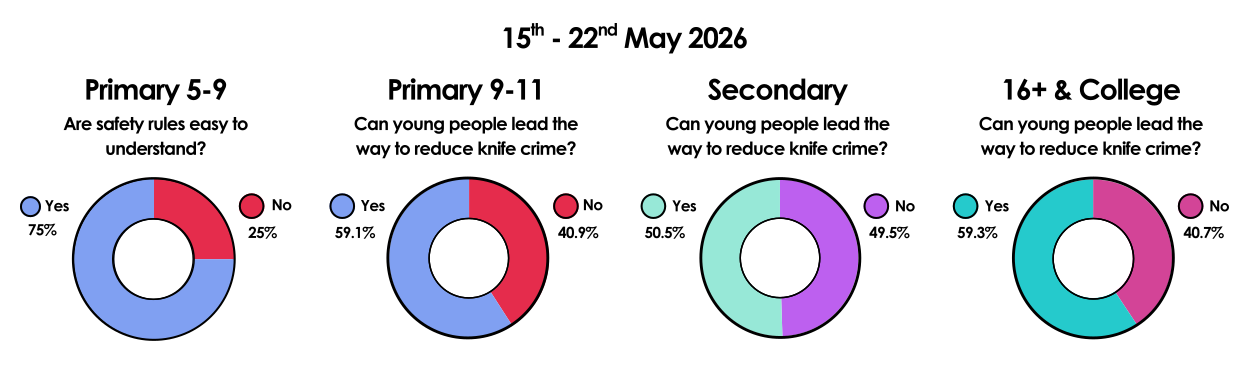
Primary 9-11, Secondary, 16+ & College voters discussed, "Can young people lead the way to reduce knife crime?", while Primary 5-7 voters were asked, “Are safety rules easy to understand?”

45,645 young people voted on this topic, with more engaging in discussions in their classrooms across the country.

Knife Crime Child

Age 5-11 voter

Children can protest or do more work on this in schools but ultimately it is down to the government.

Knife Crime teen

Age 11-16 voter

Young people can help but adults are the ones who can do the most. It's not only young people carrying knives; it's adults too.

knife crime student

Age 16+ voter

There should be more youth clubs/skate parks to keep young people off the streets to reduce knife crime.

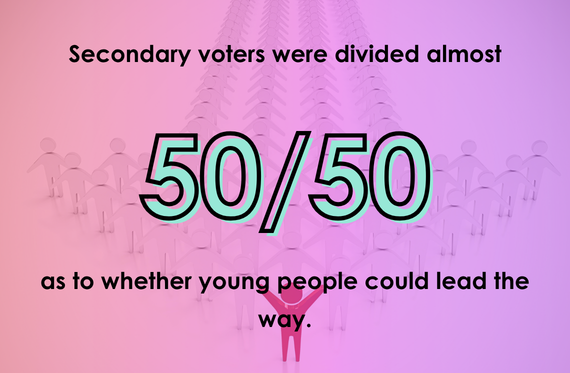
Secondary voters were divided almost 50/50 as to whether young people could lead the way.

  • Across all age groups, voters were divided as to whether young people could lead the way to reduce knife crime.
  • Secondary saw the greatest split, coming it at almost exactly 50/50 for and against.
  • Many thought it was too big an issue for young people to tackle on their own.
  • Some 'Yes' voters pointed out that it is an issue disproportionately affecting young people and so they are uniquely well situated to help stop it.
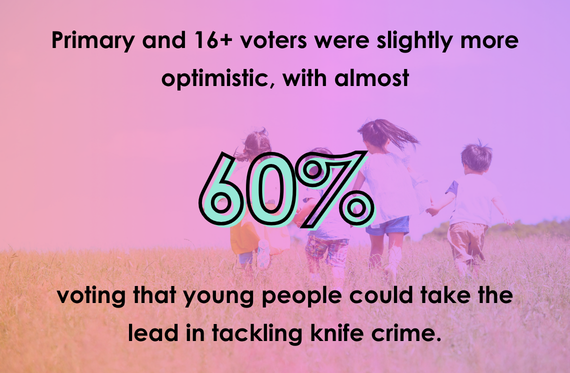
Primary and 16+ voters were slightly more optimistic, with almost 60% voting that young people could take the lead in tackling knife crime.

  • Both Primary 9-11 and 16+ voters were slightly more likely to vote Yes than their Secondary peers.
  • Both discussed how that, if young people are the ones carrying knives, then it is up to them to take the lead in stopping it.
  • They still shared the concern that it is just too big or complex an issue for young people to solve alone.
Students recognised that peer influence means they can make changes that adult cannot.

  • A recurring theme in discussion was that of peer influence.
  • Voters spoke about how young people often look to friends and other peers for guidance and support, rather than the adults in their lives.
  • This means that young people have a unique means by which to affect positive change surrounding knife crime.
  • However, some pointed out that this goes both ways: if all those around you are carrying knives, why wouldn't you?
results